
Modeling Airflow Across 13 Million Mesh Cells to Verify Cold-Storage Performance
CFD Analysis
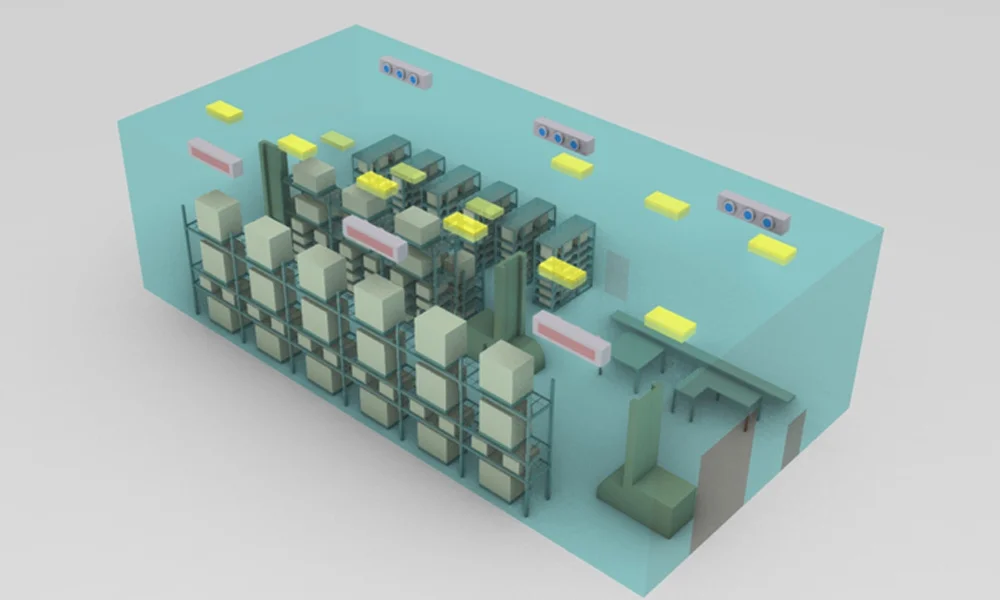
First Image: The modeled cooler interior — racking, evaporators, lighting, and forklift traffic.
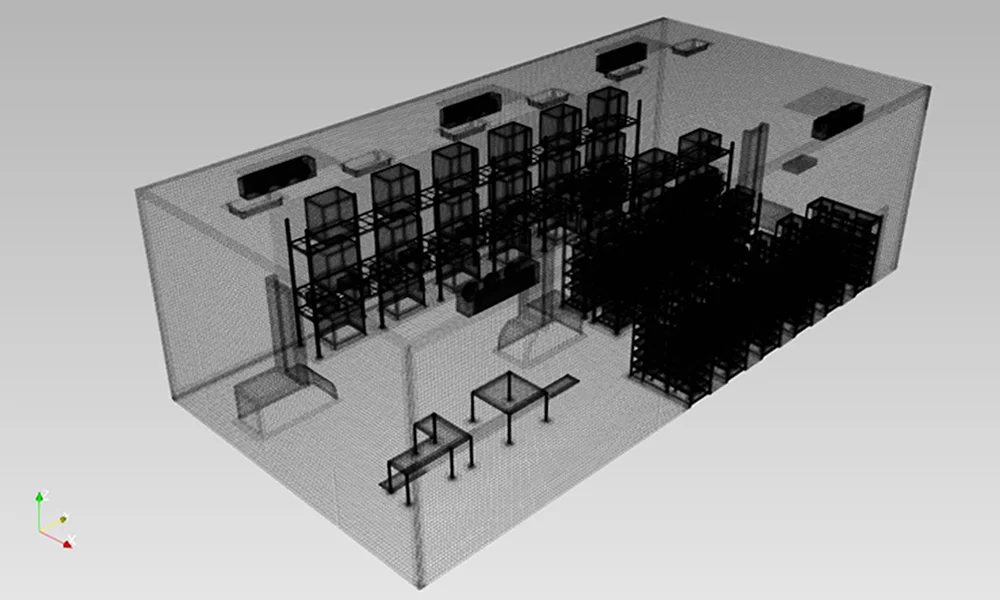
Second Image: The 13-million-cell mesh used to resolve airflow at that level of detail.
- Refrigerated Warehouse Cooler
- Winnipeg, Manitoba
- CFD Analysis for Canadian Client
Case Study Summary
Service | CFD Analysis (airflow & thermal distribution) |
Facility Type | Refrigerated distribution warehouse — cooler / cold storage |
Location | Winnipeg, Manitoba, Canada |
Software | Engys Helyx CFD |
Mesh Size | ≈13 million cells |
Evaporators Modeled | 6 total — 3 active (cooling), 3 standby (recirculation only) |
The Challenge
One of our clients refrigerated distribution warehouse in Winnipeg operates its cooler with only half its evaporators actively cooling at any given time — 3 of 6 units, with the remaining 3 left on standby, still recirculating air but doing no active cooling. That’s an efficient way to run the space, but it raises a real operating question: does reduced cooling capacity create warm pockets near stored product, especially close to doors and walls where heat infiltration is highest? For a cold-chain facility, the cost of finding out the hard way isn’t a support ticket — it’s spoiled inventory.
Our Approach
We built a full 3D model of the cooler interior from the facility’s CAD drawings — racking, evaporators, doors, lighting, and forklift traffic included — and resolved it with a 13-million-cell mesh, fine enough to capture local airflow behavior around racks and doorways, not just a bulk average for the room.
Boundary conditions were built from real operating data rather than generic assumptions: measured evaporator flow rates and supply temperatures, wall/floor/ceiling heat gains, door infiltration loads (including the roll-up door), product heat loads, and forklift, lighting, and occupancy heat — each sourced from the facility’s actual design and equipment information.
A detail that mattered for accuracy: the 3 standby evaporators weren’t excluded from the model. Even though they weren’t actively cooling, they were still moving air through the space — recirculating at their return-air temperature and still generating fan heat. Modeling them as genuinely inert would have understated how the space actually mixes air. Getting that distinction right was necessary to trust the mixing pattern the results showed, not just the headline temperature.
The steady-state simulation was run matching real operating practice — 3 evaporators active, 3 on standby — and results were evaluated as temperature and air-speed contours across more than 30 section planes through the space, rather than a handful of spot checks.
Results
0.4°C
Average air temperature achieved, running on just 3 of 6 evaporators (2°C set point)
13M
Mesh cells resolving airflow in fine local detail, not bulk averages
< 4°C
Peak temperature reached anywhere in the core cooler, even under the widened analysis range
No hot spots were observed near stored product anywhere in the cooler. Minor warm spots did appear near the front wall and the roll-up door — both explained by wall and door infiltration heat gain — but neither reaches the racked product; the roll-up door’s warm zone in particular sits well away from any racking. Air speed contours showed good, consistent mixing throughout the space, meaning the cooling load isn’t just adequate on average — it’s actually reaching the whole room.


Left: air temperature contour through the cooler — the warm zone at right is the front-wall/door area, well clear of product racking. Right: air speed contour showing mixing patterns from the active evaporators.
Why It Mattered
This confirmed, with data rather than assumption, that McKesson’s reduced-capacity operating mode — half the evaporators active, half on standby — doesn’t compromise cold-chain integrity anywhere near stored product. It also mapped precisely where the (minor, harmless) warm zones sit, which is useful both as a validation record and as a reference if the facility’s layout or door usage changes in the future. That’s the kind of operating question a facility can otherwise only answer by trial and error — with real product on the line.